BEFORE STAR WARS: HOW U.S. MILITARY TECHNOLOGY INFLUENCED THE FILM FRANCHISE

Long before Star Wars introduced audiences to hovering speeders, towering walkers, and futuristic war machines, the U.S. Army was already experimenting with remarkably similar technologies. What many viewers assume are purely Hollywood inventions were, in some cases, rooted in real US military technology research conducted decades earlier.
These projects were not props or fantasy concepts. They were serious attempts to solve battlefield mobility problems—how Soldiers could move faster, cross difficult terrain, and gain tactical advantages. While most of these experiments never became standard equipment, their designs are strikingly familiar to fans of sci-fi.
Here are some of the real-world military innovations that look as if they came straight out of a galaxy far, far away.
What Is the Real-Life Speeder?
Most people remember Luke Skywalker racing across the desert in a landspeeder. What is less known is that, years before Star Wars existed, the U.S. Army was already testing a real-life version of a personal hovering vehicle.
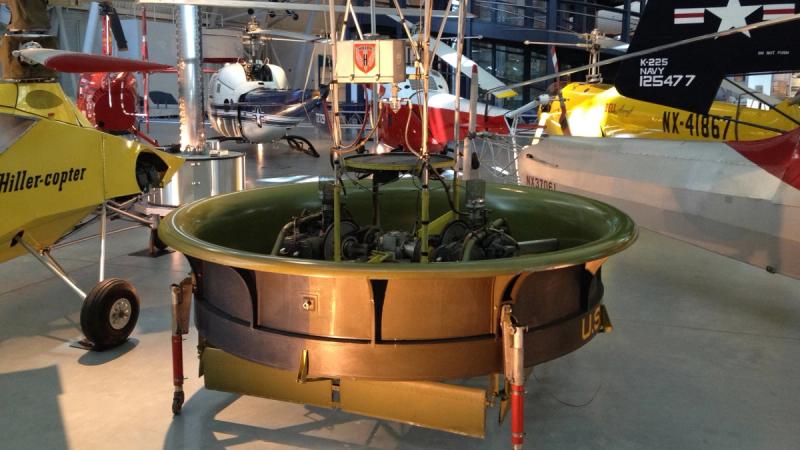
The Hiller VZ-1 Pawnee
Developed in the 1950s, the Hiller VZ-1 Pawnee was a single-Soldier flying platform designed to hover just above the ground. The goal was simple: allow Troops to cross terrain that was too dangerous, slow, or impractical to navigate on foot.
The design was unconventional. The VZ-1 consisted of a circular platform mounted above two ducted rotors. The pilot stood upright on top, balancing while the rotors provided lift. Control was achieved almost entirely through shifts in body weight.
In practice, this made the craft extremely difficult to operate. Pilots were essentially balancing on a flying platform only a few feet above the ground. Any loss of balance could be dangerous, and the low altitude offered no real protection or tactical advantage.
Although the VZ-1 never entered operational service, its resemblance to sci-fi speeders is undeniable. It remains a fascinating example of how real military experimentation can mirror cinematic imagination.
The General Electric Walking Truck
One of the most iconic machines in Star Wars is the AT-AT walker—an enormous, four-legged armored vehicle. Surprisingly, the Army explored a similar concept years earlier.
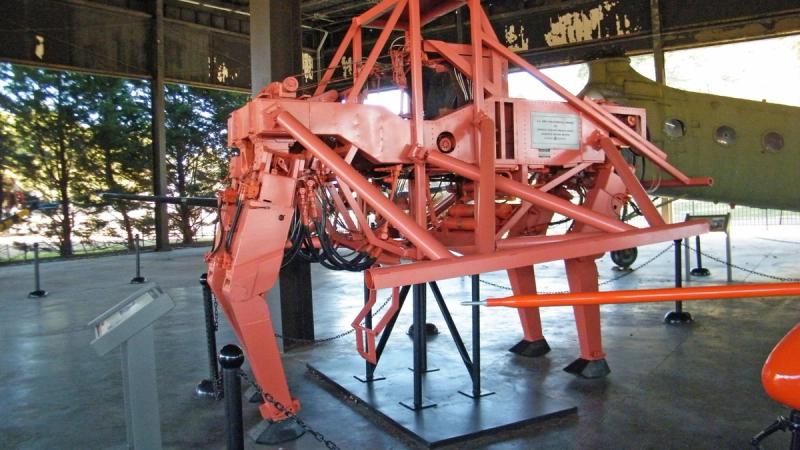
The Cybernetic Anthropomorphous Machine
In the 1960s, engineer Ralph Mosher designed the General Electric Walking Truck, officially called the Cybernetic Anthropomorphous Machine. Despite the futuristic name, the machine was very real.
This four-legged vehicle was powered by hydraulics and operated by a human pilot. Unlike modern autonomous systems, it required full-body control. The operator moved their arms and legs to command each mechanical limb, effectively mimicking the machine’s motion.
While the concept worked, it came with major drawbacks. Operating the machine was physically exhausting, the vehicle was extremely heavy, and it was impractical for real combat environments. Still, its resemblance to sci-fi walkers is striking, and it left a lasting impression as one of the most memorable military experiments of its time.
The Army’s Hovercraft Experiments
As military operations expanded into riverine and swampy environments during the 1960s and 1970s, the Army sought vehicles that could move seamlessly over land and water.
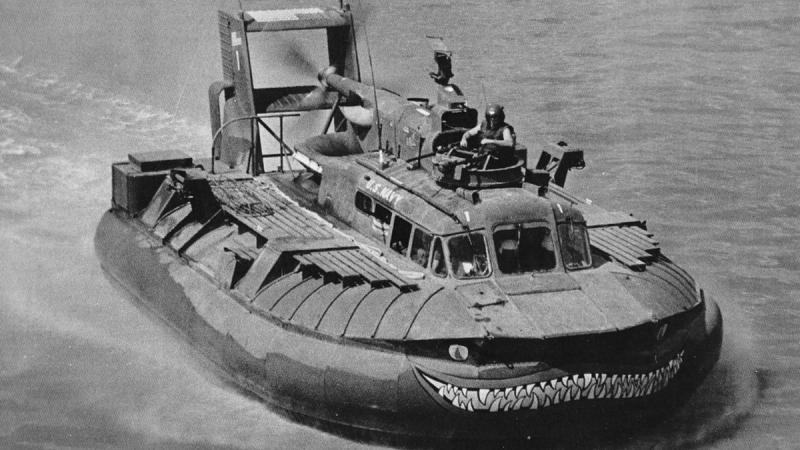
The Bell SK-5 Air Cushion Vehicle
This need led to the development of hovercraft such as the Bell SK-5, which was tested during the Vietnam War. The vehicle used an air cushion to glide over water, mud, and flat terrain without transitioning between modes of transport.
While the concept showed promise, the execution had serious limitations. The SK-5 was extremely loud, required heavy maintenance, and produced large amounts of spray and debris. In combat situations, stealth is critical, and the hovercraft is impossible to conceal.
Despite these issues, the design demonstrated an important step toward amphibious mobility. Its shape and movement are reminiscent of sci-fi hover vehicles, even if the technology was not yet refined enough for widespread use.
From Test Fields to the Big Screen
These projects were not obscure or forgotten experiments. In 2015, the U.S. Army itself published material highlighting how many of its past mobility programs closely resembled science-fiction concepts. While there is no official confirmation that Star Wars filmmakers directly borrowed these designs, the similarities are difficult to ignore.
Some of these machines can still be seen today at the U.S. Army Transportation Museum at Fort Eustis, where they stand as reminders of how military innovation often pushes the boundaries of imagination.
Most of these technologies never became standard military equipment. However, their value lies in what they inspired. They expanded the possibilities of design, influenced future research, and captured the imagination of engineers, filmmakers, and audiences alike.
So the next time you watch Star Wars, remember this: some of its most unforgettable machines did not begin in a distant galaxy. They began on Army test fields, hovering, walking, and gliding their way into science-fiction history.
Suggested reads:

BY ALLISON KIRSCHBAUM
Veteran, Military History & Culture Writer at VeteranLife
Navy Veteran
Allison Kirschbaum is a Navy Veteran and an experienced historian. She has seven years of experience creating compelling digital content across diverse industries, including Military, Defense, History, SaaS, MarTech, FinTech, financial services, insurance, and manufacturing. She brings this expertis...
Credentials
Expertise
Allison Kirschbaum is a Navy Veteran and an experienced historian. She has seven years of experience creating compelling digital content across diverse industries, including Military, Defense, History, SaaS, MarTech, FinTech, financial services, insurance, and manufacturing. She brings this expertis...