ERIN GO BRAG: THE HISTORY OF ST PATRICK’S DAY AND IRISH IMMIGRANTS IN THE US MILITARY
COMMENT
SHARE

Green clothes. Windows and walls covered in shamrocks. Constantly flowing kegs of Guinness and shot glasses brimming with whiskey. Trying to remember the words to songs like “Whiskey in the Jar” and “The Rising of the Moon.” Googling how to make soda bread. These are some of the most popular ways we American’s, whether our ancestors hail from the Emerald Isle (as half of this writer’s forebears do) or not, celebrate Saint Patrick’s Day.
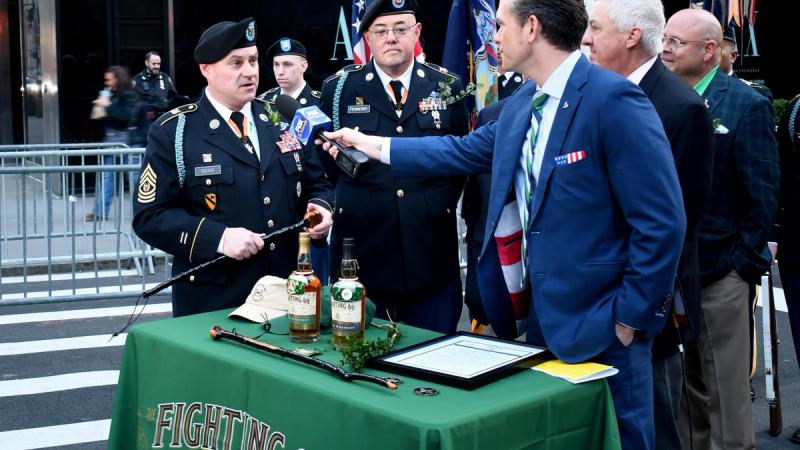
A day with obvious and explicit religious roots that’s nevertheless celebrated by Americans of all religions and backgrounds. One that many cities and towns go so far as to mark with an annual parade, perhaps none so massive and grandiose as the one held in New York City. An event that, every year since 1851, has been led by the Soldiers of the Army’s 69th Infantry Regiment, a unit formed entirely from Irish immigrants over 170 years ago. But the ties between Irish immigrants and the United States military goes back even further than that.
The History of Saint Patrick's Day
Before we delve into military history relating to this particular holiday, let’s examine the holiday itself, though the details of its origin are as steeped in assumption and myth much like the stories of most saints. Born in 5th century Britain to a Christian family, pre-sainthood Saint Patrick was captured and enslaved by Irish raiders at the age of sixteen.
After living in bondage for the next six years, he managed to escape and eventually reunite with his family. But rather than remain in his home country, he decided to return to the island of his captivity with the intention of spreading the religion he relied on for solace during his time as a slave. He proved so successful in that task that he is credited as the man who brought Christianity to Ireland.
As with all Catholic saints, Patrick is credited with several miracles. Most famously he supposedly drove all the snakes in the country into the sea and used the tri-leafed shape of a shamrock to explain the concept of the Holy Trinity. After perishing sometime in the latter half of the century during which he lived (the exact date of his death is unknown, but March 17th of 461 is the most commonly alleged day of his demise), the Irish began considering him a saint.
As this all occurred centuries before the Catholic church adopted the formal procedures for recognizing someone as a saint, Saint Patrick was never formally canonized. Nevertheless, popular recognition has solidified over the centuries, and he is now recognized as the patron saint of Ireland.
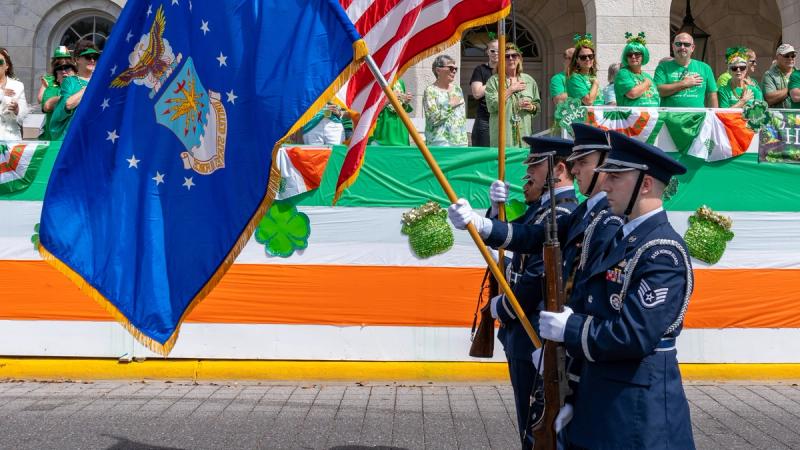
The Irish in the Revolutionary War and America’s Early Years
Irish men and women have been immigrating to America since before the founding of the United States. And when the War of Independence broke out in 1775, the colonies were full of Irish men and women. Many of the former were then serving as members of the British military fighting to retain the crown’s control of her erstwhile colonies. But others pledged their service to the fledgling nation instead, including two of General George Washington’s aides-de-camp: Doctor James McHenry and John Fitzgerald. The former, an Army surgeon, went on to serve as America’s third Secretary of War and the namesake of the very fort whose defenders during the War of 1812 inspired America’s national anthem.
Irish immigrants and Irish-Americans continued to serve in the US Armed Forces as the young nation grew stronger and larger in the late 18th through mid-19th centuries. Though that is not to say the interactions with emigrants from Ireland always led to seamless cooperation and integration.
For example: during the 1846-1848 Mexican-American War numerous Americans of Irish birth or descent joined the Mexican Army’s all-Irish unit (the San Patrico Brigade) out of a desire to serve a county that predominantly shared their religious beliefs (many Americans being hostile to Catholics at the time). This, in turn, led to a rather infamous event when the US Army executed a group of captured San Patricios during the pivotal Battle of Chapultepec in 1847. Nevertheless, the Irish continued to contribute their lives and services to the American military.
The Civil War and the Fighting Irish
Arguably the most widely recognized and highly concentrated contributions of Irish Soldiers to the defense of America and its ideals took place during the Civil War. The Union Army consisted of both regular Army formations, state militias, and a wide array of hastily organized military formations. Among them was the 69th Infantry Regiment, a unit of the New York State Militia founded in 1849 and made up entirely of Irish immigrants, many of whom who’d left their home country as a result of the devastating effects of the disastrous and deadly Great Famine of 1845-1849 that killed of a large portion of Ireland’s population.
While Irish-Americans fought in units both segregated and integrated on both sides of the Civil War, it was arguably the exploits of the 69th that originated the association of the sons and daughters of Eire with our nation’s military successes. The unit earned widespread recognition for its battlefield bravado in many of the war’s major battles; its tenaciousness in the 1862 Battle of Fredericksburg led the enemy commander General Robert E. Lee to refer to it as “that fighting 69th,” the origin of the regiment’s nickname.
It served at in many of the war’s major engagements, including the Battle of Gettysburg, and included among its commanders one of the most legendary Irish rebels who fought against English rule only to escape to America, Thomas Francis Meagher (while it would distract too much from the focus of this article to dive into, Meagher’s life is so absurdly fascinating we wholeheartedly insist you look into it on your own).
Irish Americans and Immigrants in the Modern Armed Forces
The modernization of the US military in the decades after the Civil War ended the traditions of localized units and those made up of specific ethnic groups in the late 19th century (though, sadly, the armed forces remained racially segregated until 1948).
But Irish immigrants and their descendants continued to serve in all branches of the United States military. From Medal of Honor winner Audie Murphy to recent Chairman of the Joint Chiefs of Staff Mark Milley, the Irish and their descendants continue to prove their dedication to the United States by serving in its armed forces.
Saint Patrick’s Day in America
As with all immigrants, the Irish who came to America over the centuries brought much of their culture with them. The first known Saint Patrick’s Day parade in North America took place in Boston, Massachusetts in 1737, nearly forty years before the United States even existed.
The New York City parade, the one now headed by the troops of the 69th, dates back to 1762. Since then, American citizens, residents, and immigrants have celebrated this most Irish of holidays.
The US Military and Other Cultural Holidays
Given all this history, the inclusion of the Armed Forces in annual celebrations hailing Irish culture is understandable. Far more curious is the recent decision to bar the US military from observing occasions that celebrate other cultures and ethnic groups with equally important ties to our nation’s history. In January of 2025, the Department of Defense declared its formal recognition of annual cultural observations (among them Black History Month, Women’s History Month, Asian American and Pacific Islander Heritage Month, Pride Month, National Hispanic Heritage Month, National Disability Employment Awareness Month, and National American Indian Heritage Month) “dead.”
Additionally, Secretary Pete Hegseth ordered the DoD to take a “passive approach” to Juneteenth, the federal holiday honoring when, on June 19th of 1865, Union Soldiers informed the black residents of Galveston, Texas that they were no longer enslaved. Certain agencies in the Department have also paused official observances of additional holidays like Martin Luther King Jr. Day and Holocaust Remembrance Day.
Yet despite all that, the DoD continues to allow formal recognition of Saint Patrick’s Day by bases and units across the country. And, as usual, the 69th will lead the parade along NYC’s 5th Avenue. Why this particular holiday combining cultural and religious traditions is seemingly the only one the current leaders of the Defense Department deem worth honoring is the subject of much speculation.
After all, African Americans, women, Asian Americans, Pacific Islanders, members of the LGBTQ+ community, Hispanic Americans and Latinos, those with disabilities, and Native Americans have more than their fair share of members who served this nation’s military with honor and courage. Eliminating occasions honoring those groups while keeping Saint Patrick’s Day strikes many as questionable. It’s commonly held that their dismissal stems from the Trump administration's scorn for all things related to Diversity, Equity, and Inclusion (DEI).
All that said, questionable choices by DoD brass should not prevent you from raising a glass or two (or more) to the Irish men, women, and descendants who bravely served this country in uniform. To all of whom I say Semper Fidelis and Erin Go Bragh!
Suggested reads:
Join the Conversation

BY PAUL MOONEY
Veteran & Military Affairs Correspondent at VeteranLife
Marine Veteran
Paul D. Mooney is an award-winning writer, filmmaker, and former Marine Corps officer (2008–2012). He brings a unique perspective to military reporting, combining firsthand service experience with expertise in storytelling and communications. With degrees from Boston University, Sarah Lawrence Coll...
Credentials
Expertise
Paul D. Mooney is an award-winning writer, filmmaker, and former Marine Corps officer (2008–2012). He brings a unique perspective to military reporting, combining firsthand service experience with expertise in storytelling and communications. With degrees from Boston University, Sarah Lawrence Coll...